Showing posts with label Painting. Show all posts

Wednesday, February 16, 2011

Gerhard Richter: Painted Photographs

We know that the emergence of photography in the mid-19th century gave rise to heated debates on whether or not these new images could be considered a faithful reflection of reality, whether or not photography could be considered a new kind of art, and if so, whether this would signal the end of traditional pictorial representation. The passage of time has led photography to become a part of museum collections, and it has won the status of an independent art genre, a genre that has not only not displaced painting but that in fact engages in dialogue with painting in the oeuvre of many artists. In the works of Richter, all of them small-format, the artist draws simultaneously from painting and photography procedures to describe his everyday, private life. In the images that comprise "Painted Photographs", he acts on the original instant snapshots using a variety of painting techniques: sometimes he drags certain fragments of the photograph over still-wet paint so that the layers of oil form drawings with different textures and densities on the resulting work; other times, he places the photograph on a certain spot on the edge of the spatula and spreads paint over it, or he sprinkles drops of color over the snapshot or immerses the picture in diluted shellac. The multidisciplinary output of Gerhard Richter, born in Dresden in 1932, often offers unexpected associations that situate viewers between the public and private, the realistic and the abstract, and beckons them to reflect on whether what they are seeing can be regarded as a faithful copy or the artists subjective intervention. After working as an advertising and stage painter, Richter studied at his native citys Fine Arts Academy. During that period, he made a number of murals that were later painted over for ideological reasons when he had to flee from East Germany to seek refuge in the West. Since the early 1970s, his work, which shows influences from American Abstract Expressionism and Pop Art, has often been exhibited in Europe and the U.S.A. In 2002, New Yorks MoMA devoted a sweeping retrospective to his oeuvre, the most extensive one that this museum has ever held for a living artist.


Saturday, December 25, 2010

De la Tierra. The more RURAL collection of Museo Reina Sofía.

Art works selected in this post are linked to Spanish countryside of the XX.
They can be seen in the permanent collection of National Museum of Contemporary Art Reina Sofia in Madrid. They were chosen by Jesus Carrillo, Chief of Cultural Programs in MNCARS, within the International Conference Campo Adentro held in Madrid the month of October 2010.

All the works can be seen in the Museum's permanent collection, distributed over several rooms on the second floor.


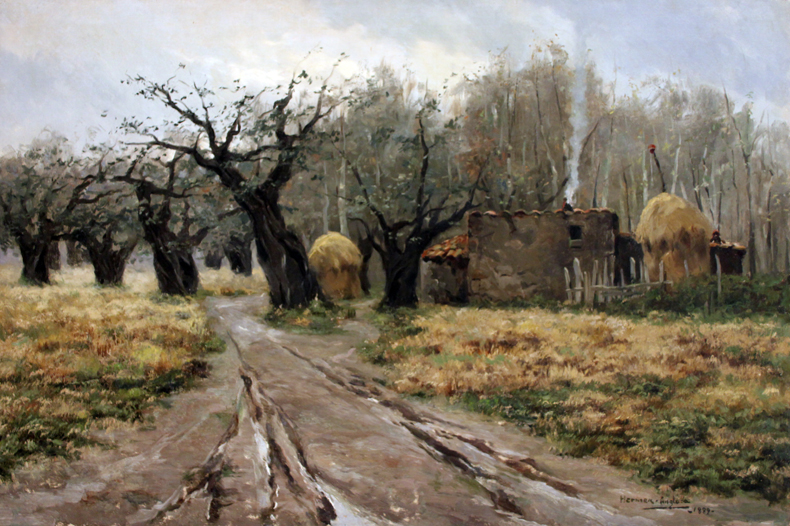
Hermenegildo Anglada-Camarasa, Paisaje (In the wood), 1889. Oil on canvas.
José Ortiz-Echagüe. Lagarteranas (Women of Lagartera). 1925, Charcoal on laid paper.
Ignacio Zuloaga. El cristo de la sangre (Christ of Blood), 1911. Oil on canvas.
Joaquín Mir. El huerto y la ermita (The Orchard and the Shrine). ca. 1896. Oil on canvas.
"España Negra" Travel Notes. Translation and Illustration:  Darío de Regoyos.
José Gutiérrez Solana. La visita del Obispo (The Bishop's Visit), 1926. Oil on canvas.
Julio González, Campesina sentada (Seated peasant Woman). ca. 1920-1925. Oil on canvas.
Manuel Hugué (Manolo). La Llovera, 1910-1911. Terracota modelada. 
Joaquín Torres García. El orador (The Speaker). 1905-1906. Oil on canvas.
Joan Miró. La casa de la palmera (House with Palm Tree). 1918. Oil on canvas.
Darío de Regoyos. La viña (The Vine). ca. 1900. Oil on canvas.
Benjamín Palencia. Pueblos (Villages). 1925. Oil on canvas.
Salvador Dalí. La Jorneta. ca. 1923. Oil on canvas.