Showing posts with label Photography. Show all posts

Thursday, February 13, 2014

José Manuel Navia - Tablas de Daimiel National Park, Spain 2010


Today i came across this photographer José Manuel Navia and his body of work Tablas de Daimiel National Park, Spain 2010. Browsing through the photographers of agence vu i noticed this body of work. I was intrigued how José had captured the magic of this national park and created a strong narrative that follows this story. I was most intrigued by his portraits and the way he has photographed them in a very natural way. Im not saying that they haven't been staged however they still feel as if he wasn't present when the photograph was taken. This is interesting to me as i am still tumbling through the possibilities of how i could photograph the portraits that will be part of my body of work. I also liked how he has photographed the landscapes within this body of work and how they all carry the same colours, relating to each other and creating a flowing feeling to the images as they unravel. Here is the caption that accompanies this body of work;
Tablas de Daimiel National Park (Parque Nacional de las Tablas de Daimiel) is a nature reserve in south-central Spain on La Mancha plain in the province of Ciudad Real. It is a floodplain wetland in an arid part of Spain created where the Cigüela river joins the Guadiana river.
It enjoys international recognition as a wetland on the list of the Ramsar Convention. The European Union designated it a Special Protection Area for birds . It is home to many bird species, some year-round residents, some migratory. Among the flora, aquatic plants are the basic substrate of the Tablas, and the only trees present are the tamarisk trees. It is one of the most important aquatic ecosystems of Spain and was probably the main inland wetland.
The wetland landscape is characterized by recurrent seasonal inundation which until recently was maintained by both river flooding and groundwater discharges. The Tablas are provided with two types of water making an unusual ecosystem: the Guadiana contributes fresh water, while its tributary the Cigüela is brackish.
The Tablas de Daimiel had a long tradition of waterfowl hunting. Spanish kings from Infante Don Manuel in the 14th century to Alfonso XIII at the turn of the 20th century, hunted in these parts. The water resources of the area also provided fishing and power for mills. One of the major human modifications in Las Tablas and around until the 20th century were the mills. It came to count up to 14 mills, some of which dates back to medieval times. The mills were social centres where the wheat was ground, fishing and hunting was sold and you could eat, sleep and exchange products.
In recent years demand for water for agriculture in the area surrounding the park has reduced the amount of wetland. Overexploitation of water resources has caused the water-table to drop. The key aquifer has not been able to refill because of illegal wells and canalisation of the rivers. Early in 2010 the situation was improved by heavy rainfall and an emergency transfer of water from the Tagus. 


From Thomas King Documentary Photography Blog
http://thomaskingdocumentaryphotography.blogspot.com.es/2012/11/jose-manuel-navia-tablas-de-daimiel.html 
http://www.agencevu.com/stories/index.php?id=934&p=63 
More José Manuel Navia works in: http://jmnavia.blogspot.com.es/2013/10/nostos-navia.html 
http://jmnavia.blogspot.com.es/2007/01/territorios-del-quijote.html

Sunday, October 6, 2013

Jorge Fuembuena

Jorge Fuembuena (Zaragoza, 1979). Live and works in Madrid and Nantes
He explores the boundaries of the subject and the fragile boundary that separates the individual from another, and investigates the relationship between human and his environment.
He has developed his creative process in Artist Residence Programs such as the Contemporary Art Center in Essaouira ( Marroc), the Upernavik Museum (Greenland) or the Noass Art Proyect in Latvia.
Fuembuena’s work has attracted many accolades. In 2011, he was awarded with Air Fellowship. Kultuuritehas Polymer. Tallinn, OCEMX Mexique D.F. Prize , Art Generations Caja Madrid 2011 and ARCO portrait Photographer or as well as finalist in both the International Festival Emergent. In 2009, he was announced as the Emerging Artist Award in the St.Isabel of Portugal Art Prize .
As well, he was awarded with the Sta. Maria de Albarracin Grant or the Encontro New Artist Grant . His work has been selected in Photoespaña 2011 Festival and nominated in the 2011 European Sovereign Art Prize ( Hong Kong) or Fotomuseum Wintherthur Plat(t)form 2013.
His work has been published in magazines such as OjoDePez, EFE24, New_Papers , 30y3, PMS 485C,...
His work has been exhibited both nationally and internationally and is included in public and private collections such as Buñuel Foundation or CDAN.
http://www.30y3.com/esp/?cat=64 
Light without Shadows
Lola Garrido

Light is the first animal of the invisible.
José Lezama Lima 

Truth exists, only falsehood has to be invented.
Georges Braque, Pensées sur l'art

The portrait’s appearance becomes strange when cold and inert faces emerge from the mirror. Jorge Fuembuena draws the world with a luminous gaze that crosses the glow and triggers a definite sensory confusion, a style of photography that at times is lucid in its near invisibility. His is a visual aesthetic that makes one think of what is ideal, static and transparent, and of the timeless work of modernist romantics, a non-saturated, highly subjective way of seeing, so emotionally distant that it is almost impersonal.
The dramatism provoked by this full luminosity that can even blind us invokes the celestial and returns a clearer image to us.
Jorge Fuembuena’s photography is free of shadows. Beyond their white boundaries, a stony calm prevails in his images, caused by their radiant characters capable of extending a halo of light and inspiring in the viewer a powerful illusion. Observing Fuembuena’s images, you tend to think that the light has still not arrived, that the perceptible has vanished and that some thread of a dark shadow will arrive immediately.
In his essay Camara Lucida (1980), Roland Barthes asserted that if you couldn’t delve deeply into photography it was because of its evidence. In the past, photography was used to record an unfathomable reality; it was like a live trace of an unrepeatable moment. Contemporary photography is also light writing, but its language is the perfect bait for a trap. Jorge Fuembuena’s photography is a good example of these aesthetic coordinates, an exercise in full luminosity that becomes magic where the transparency in the image’s limpid shapes confronts sparks of dark signs that make it very difficult to decide whether the message is real or invented.
His shots imply a certain mystery or bear something unexpected without revealing any secrets. And if we continue to speak the normal language of commonplaces they touch on truths that continue to be important as time advances. To put it briefly, these carefully selected photographs are not only beautiful, they are as far as they can possibly be from what is trivial or gratuitous. Jorge traps us with a fantastic luminosity and deploys a mysterious poetic atmosphere that envelops, seduces and captivates us, making us believe that these blurred photographic images are the perfect representation of what is real.
And in doing so, he defines post-modern art in good measure, because he defends a purified aesthetic that encloses an ironic, penetrating discourse. In this direction, current emerging art makes spiritual contact with the mannerist movement. Refined manners, wrapped in a gracious environment are no more than a mask for complicated moral difficulties.
In this artist’s photography one senses a delicate synthesis emanating from irony. His characters are shown as concentrated yet uneasy and they are part of settings that have been devised based on a discourse of studied iconography. Aby Warburg – the father of the iconological trend – would tear apart every gesture in search of telling notes on personality, a condition that reveals the portrait’s subject by resorting to the collective unconscious, which offers more data than what is shown by simple appearance.
This discourse contains less clarity that it seems, and to illustrate one of the series with greatest perspective, Fuembuena recruits a group of characters to bring them face to face with their backs to reality. These are portraits that disturb, that bear a personal seal. The same impatient sensation is produced by the Holidays series of landscapes. This cycle of images confronts a reflection on “artisticity”; at first they seem to be ordinary everyday snapshots of mundane subjects. Only a closer approach leads to a critical introspection that reaches a metaphysical dimension: a kind of ecstatic concentration between the human being and his world.

Tuesday, February 28, 2012

David Spero "Settlements"

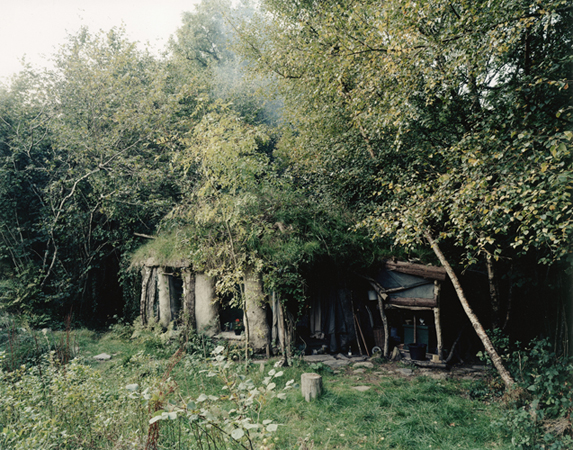
'Settlements' is an ongoing photographic record of self-built homes and structures in a 
number of low-impact land-based communities in Britain that wish to explore ways of 
living on the land in an ecologically sustainable way. Their aim is to be at least partially 
self-sufficient. They use renewable energy sources, grow food, and recycle and locally 
source building materials. These photographs chart the evolution of these communities 
through their homes, communal spaces and infrastructure.
Planning conflicts surrounding these structures raise questions about planning values and 
judgments, the privileged gaze, aesthetic elitism and who is allowed access to live and 
work on the land.  The communities have been slowly challenging and shaping changes in 
judgments on planning laws and its application at a local level.

Photographs
'The Longhouse'  communal space and new kitchen, Steward Community Woodland, Devon, November 2004 
John, Sonya, Daisy, Marley & Asher's, Steward Community Woodland, Devon, August 2004
Brigyn's, Tir Ysbrydol (Spirit Land), Pembrokeshire, October 2004
Emma and John's, Tir Ysbrydol (Spirit Land),Brithdir Mawr,  Pembrokeshire, October 2004.
Communal round house and kitchen, Tinkers Bubble, Somerset, February 2006
Mary and Joe’s, Tinkers Bubble, Somerset, June 2004 
Josh's garden and new communal yurt, Land Matters, Devon, November 2008
Robin and Annie's and communal garden, Land Matters, July 2009
All prints are 604mm x 750mm

Photographs by David Spero 

Saturday, February 25, 2012

José Navarro "Trashumantes"


Every November a small group of Spanish semi-nomadic shepherds from Teruel set off on a 3-week long journey and walk a flock of 5,000 sheep across 250-miles of Spanish landscapes. They leave behind the exhausted summer pastures of their native Serrania de Albarracin and head for greener, winter hillsides in Jaen, Andalucia.
They are the ‘trashumantes’, the very last ones who still practise a 1000-year-old tradition on such a large scale.
I recently accompanied them for the whole duration of their seasonal migration. This project took three years from inception of the idea to realisation. A series of sheep epidemics and the subsequent government ban of nation-wide movements of animals almost finished off the already precarious lifestyle of the trashumantes.
During the journey I felt the pervading sense of camaraderie amongst them and witnessed how the activity completely defines who they are. They are trashumantes and could not, would not, be otherwise. Sadly, they’re often seen as an anachronism in our technology-driven society. However, for the trashumantes the journey is not an exercise in nostalgia but a cost-efficient, environmentally-friendly alternative to road transport: they save money by walking the sheep instead of taking them in lorries. So the activity is unquestionably rooted in a modern market economy.
I don’t know how long they will keep doing it, but I hope that the young shepherds who came with us eventually take over the responsibility from the core of mature trashumantes who drove the expedition. It would be a great loss if the drovers’ tracks eventually faded in the landscape because no trashumantes walk them anymore.
All images copyright © José Navarro

Monday, October 31, 2011

Sarah Pickering "Explosion"


Sarah Pickering's photographs jar our sense of security and illuminate the ways in which we cope with traumatic events that are beyond our control. Her pictures depict environments and events crafted for the purpose of training policemen, firemen, and soldiers for calamities such as terrorism, civil unrest, fire, and war. By exposing the absurdity and controlled nature of these environments, Pickering's images reveal our predilection to deflect fear by trying to anticipate and plan for it--and our tendency to process it by turning it into narrative. Ultimately Pickering's photographs raise questions about the efficacy of preparedness and hint at the psychological effort needed to combat and recover from trauma--the struggle to live with the anxiety, the invisible violence, that accompanies security…Pickering's photographs are documentary, yet complicated by the fictitious, theatrical nature of the subjects she records."
Karen Irvine, excerpted from her text to Explosions, Fires, and Public Order


Sarah Pickering researches truth versus verisimilitude through the medium of photography.  Her unmanipulated images preserve actions whose causality and construction seems to be part of an alternate, but no lesser, reality. She worked with the emergency services, pyrotechnic manufacturers and the police to produce some of her most recent bodies of work.  Exhibitions include How We Are: Photographing Britain, Tate Britain 2007; New Photography in Britain, Galleria Civica di Modena, Italy, 2008; the Victoria and Albert Museum, 2009/10; Theatres of the Real, Fotomuseum, Antwerp 2009; Manipulating Reality, Palazzo Strozzi, Florence, 2009/10. Solo exhibitions include Ffotogallery, Wales 2009,Incident Control at the Museum of Contemporary Photography, Chicago 2010 and Art and Antiquities at Meessen De Clercq, Brussels, 2011. Her monograph Explosions, Fires and Public Order is published by Aperture and MoCP. Gallery Representation is with Meessen De Clercq, Brussels.