Showing posts with label Galicia. Show all posts

Sunday, September 29, 2013

Onions in RC Monfero

This year we have collected some production of organic onions in the garden of RuralC Monfero.
In February´s waning moon we planted onions we had preserved to get seeds.
In late April we transplanted 2 "cientos" (hundreds is a measure used in this zone, "ciento, "medio-ciento") of "chata" onion (Galician onion type) .
In late August 2013 we have collected seeds for next year and the 2 cientos already grown, of which we´ll save some for replanting to get new seeds.
We have dried the others in the "hórreo" (Galicia´s traditional raised granary) and after we have braided them. By this way we can hang up to preserve them better.
You can see some pictures of this process.


.
Special thanks to our neighbour Gerardina who helped us in the whole process.

Sunday, May 19, 2013

Pickles with outbreaks of gorse


About the gorse, Ulex europaeus, those shrubs that sting and hinder paths, there are many stories in Galicia, as that which tells how someone made fuel for his car defying oil multinationals; this tale of a countryfolk who used to say, "men from that land gnaw gorse "or some popular songs about green gorse.

This year, following a guide of plants and wild fruits of César Lema, we have begun to make pickles with flowering tops (flowers not yet open).


They are peeled, putted in jars, covered with vinegar and salt and saved in closed jars. Then you can eat them as if they were capers.

There´s an old recipe since 1622, transcribed by Pamela Michael (1980), which provides advice on how to make pickles with outbreaks of gorse.


We can use them to accompany salads, pasta or fresh cus-cus.


Tuesday, December 18, 2012

New container in Alg-a

On September 2011, Cidade da Cultura de Galicia hosted the I Encuentro de Artistas Jóvenes where 100 young creators could share and discuss about current position of the artist and the future of contemporary art production.


After meeting participants were invited to make a presentation in a container located at Cidade. This proposal was the collective project "Container Inside".
A modular structure attached to Biblioteca de Galicia, or what is the same, a container as exhibition space, library and documentation center. A space with proposals of creators participants.

Container arriving at Cidade da Cultura.

On summer 2012, and before arrival of the second edition of his meeting, it was time to decide what to do with this container
From Rural C we proposed to donate to Alg-a Lab, association with whom we work and collaborate, developping different projects.
Following discussions of the participants, this was the option granted by people. So the container arrived in Alg-a, in Valadares.

Now, to use, reuse it and reuse it again in its new location.


Performance by Paulina À la Plage at Alg-a Lab on new container´s opening day.

Tuesday, November 27, 2012

NOISEmede, festival of noise and electronic music

Last 18 and 19 of August of 2012 we organized a festival of noise and electronic music in SAUMEDE, a small village in Ourense, (Galicia).
A RuralC event in collaboration with ACAS association.

Saumede has become a project of rebuilding an abandoned rural space. The place is a small village located in a biosphere reserve in south of Ourense. The association has rehabilitated houses and paths, and develops cultural activities since 2011, dynamizing socio-cultural life of the area.

Our contribution was to introduce and coordinate a day of noise in the village landscape.
For that we invited to perform various musicians and Galician groups.
Here you can watch a video summary of concerts:


Poster NOISEmede 2012


A morning visit in the village, visiting houses in process of restoration

A hundred-year-old chestnut tree

Sound check of 23 Red Ants


Hedonistas in Touch & Play 

"Neanderled", light installation by DIOSK


Koroiev performing among day and night


23 red ants

Os Gru
Pictures by Juanma LoDo & Fur Alle Falle. 

REMAGOSTO

REMAGOSTO is a Micro-festival, participatory and familiar.
Located in Piñeiro de arriba, Vilachá, Monfero, A Coruña, Galicia.
A RuralC activity coordinated by Fur Alle Falle .

Magosto is a party linked to Autumn and chestnut.
In Galicia chestnuts goes with mushrooms, first turnip´s green sprouts, good scads, and the beginning of new winter garden.
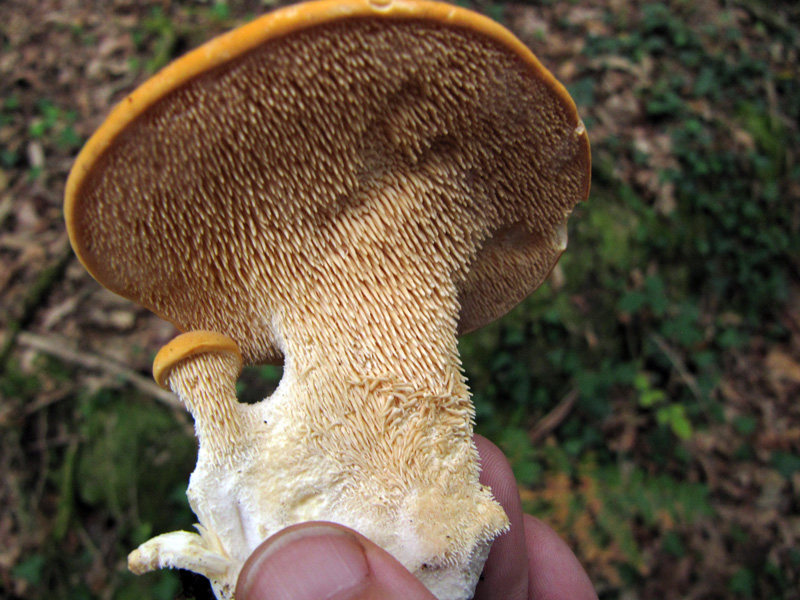
This week in mid-November in the woods we found many Hydnum repandum / rufescens, mushrooms colloquially called cow tongue or cat tongue.  The Hydnum family is characterized by these kind of stings they have under the cap (not sheets or pores).


Usually not attacked by the larvae, their flesh is dense and slightly bitter flavour, soft and pleasant. One Sunday was a good day to make them such stew of chickpeas, so it was the main course of Remagosto. After lunch, sweet "larpeiras" and liquors, including a small cake made with fluorescent yellow corn flour. 

 
After this after lunch, the concert of the engineer and poet Federico Flesfa Dublé. Galician bricotrance prepared with beautiful guitar arpeggios chained with voices, batteries with cushions, and fun polyphonic metals. It was in the loft of the house. A loft whose irregular beams were brought in 1920 from Eume´s woods.


vídeo by Marcos Nine

And after this concert, a session of slides and 16mm cinema, all with found-footage material, found or recycled. Reviewed and turned by Marcos Nine, Juan Lesta, Ximena Losada and Belén Montero.


"flounces to fly, gyga-wardrove, eels of the Albufera lagoon, indignant hostesses, children on boat, where was this airport?, sweeping a crystal Christ ..."
 

After these screenings we had improvised songs with Os Gru, talks and walk by plot, with the sound of a little owl and starry sky. We were 12 hours.

Wednesday, April 27, 2011

Cans Film Festival

From 18 to 21 May will be held in Galicia VIII Festival de Cans. The most irreverent event of international audiovisual landscape.

Cans is a village that does not exceed 400. Nestled in a valley between the Monte Castelo and A Risca, the town is structured around the old N-120 Vigo-Ourense road.

Many films, movies & audiovisuals had been sreened at this festival. Also happened too many lectures, conferences, concerts and performances. Organized by the Cultural Association Arela, formed by young people Porriño and Mos..


There are many details that give a highlighted and innovative character to this festival. This event is a real example of socio-cultural development in rural areas.

The entire village participates in the festival actively. Tractors used to move the audience, screened in private homes, warehouses, made conferences and lectures in agro spaces, lands, etc, etc.

Living proof that the field is not incompatible with the glamour.

They coined the term Agroglamour the sum of two concepts that seem irreconcilable until the arrival of the "Festival de Cans". The agroglamour defined by opposition: if Cannes is glamorous,  Cans has agroglamour.


It is curious that the two festivals coincide in time and both are regarding the outlook for global audiovisual creation, being much more interesting for us the one of the village of Cans (not depending of culture industry).

In the concept fit the red carpet on the roads, the movie stars moving in "chimpín" (decorated tractors) rather than limousine, the projections in the sheds, the relationship between neighbors and celebrities, along with the inability to wear morning dress, dress long or high heels, and absence of champagne by the absolute predominance of the caña (rum)

A brilliant and excellent production. Well done, for his attention to details, its quality and international scope, and the participation and enthusiasm generated among neighbourds of the village.  Is a clear example of global-local-global strategy

We leave here a couple of videos on the Festival, and a link to the english website


http://www.festivaldecans.com

Wednesday, January 5, 2011

Cristina García Rodero. Exhibition & Book "Transtempo" at CGAC

Spanish photographer of the prestigious Magnum agency Cristina Garcia Rodero was born in Puertollano (Ciudad Real, 1949) show us the land of Galicia and rural views in the exhibition Transtempo until February 13, 2011 at the CGAC in Santiago de Compostela. We can also see their pictures in the book Transtempo edited by La Fabrica.