Showing posts with label Art. Show all posts

Friday, August 31, 2012

Andres Montes residence at RC Villanueva de los Infantes

The Mexican artist living in Madrid Andres Montes was developing two projects at our headquarters in Villanueva de los Infantes (Ciudad Real) during the weekend from 8 to 11 June 2012.
RuralC supported the project by providing room and board, counseling, documentation and dissemination activities.

The project 
WHOLE HOUSE consisted of a performance in which Andrew dug a hole in the ground, building a living space.

We streamed his performance in La Mora, internationalizing a isolated action happened in the "middle of nowhere" (10 people from several countries were connected).


here you can view the streaming videos.

For the hardness of the ground Andrés had to make the performance in two days.


The project  TRANSPOSED | DISPLACED | TRANSPLANTED, is a continuation of his project Tactics Identity. Andrew explores the territorialization of space as constitutive of identity tool. It involved two rural areas in two different geographies: La Mora, an special spot in Villanueva de los Infantes, and the outskirts of Madrid.


1m2 of soil removed from each place to "transplanted" into the other and create a photographic record of this action. The intention is to explore, because of subtle mediation, the poetics of displacement, the thought of uprooting.


+ info at his web  http://regionestransitorias.wordpress.com/transposed-displaced-transplanted/

There was also a public presentation of their projects and career in RC Villanueva de los Infantes
It was a pleasure to have Andres on RC Infantes and be partakers of his actions.

Monday, May 16, 2011

Heiko Müller

Heiko Müller is a Hamburg (Germany) based artist who combines the surrealism of nature with art. With themes that revolve around nature with a touch of darkness, he experiments with imagery that has the ability to haunt and delight at the same time.
From his bio:
My art comes from an urge to explore. I like the countryside. I like a good view. And once I’m face to face with a lovely scenery, I feel immediately tempted to find out what it’s concealing. The dark goings-on behind the façade of nature, you might say, or the hidden machinations of the animal kingdom.
To imagine and express this, I usually tap the lines linking religious icon art, renaissance painting and comic culture. I am particularly thrilled by the kind of spiritual terror you find expressed in the paintings of the old Flemish masters, and I’m trying to find out what happens when you apply that mood to the serene and harmless world of rural folk art.
There’s something to be said about the way Heiko renders the hidden inner workings of nature’s mind; I’ll definitely look twice the next time I’m going camping! Of course if you don’t want to do the imagining so much, pick up Heiko’s prints over at Thumbtack Press.

Saturday, April 16, 2011

Catalina Bauer "Celosías" (Lattices)

Catalina Bauer "Celosías", was exhibited at "As much as possible", an exhibition curated by Luisa Fuentes Guaza that invites reflection on our ability to adapt and change our immediate environment to the extent that we inhabit.
Catalina Bauer's work illustrates a consistent preoccupation with daily routine and working lives, through the use of everyday materials, to dramatic and sublime effect.
With a clear interest in process and transformation, Bauer focuses on a specific and functional, yet sensorially pleasing material for each work. She then sets about applying a series of hand-worked manipulations, often painstaking, labour intensive processes, transforming objects and so granting them new life.
These works incorporate natural elements, inferring a notion of temporality and change, with objects of industrial production, with the intent of finding some kind of poetic balance between the two. Catalina Bauer lives and works in Santiago, Chile.

Wednesday, March 30, 2011

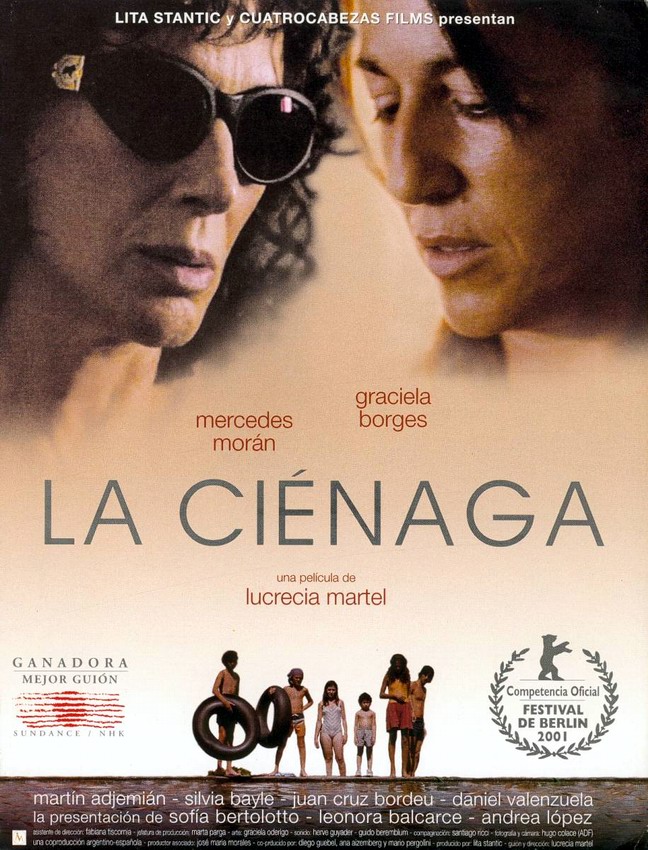
The Swamp (La Ciénaga) 2001 by Lucrecia Martel


La ciénaga (EnglishThe Swamp) (2001) is an ArgentineSpanish, and French film, written and directed by Lucrecia Martel. The film was executive produced by Ana Aizenberg, Diego Guebel, Mario Pergolini, and produced by Lita Stantic. The picture features Graciela Borges,Mercedes MoránMartín AdjemiánDaniel Valenzuela, among others. 
The picture is set in the high plains of northwestern Argentina and portrays the life of a self-pitying Argentine bourgeois family.
Synopsis: The film tells the story of Mecha (Graciela Borges), a middle-aged woman in her 50s who has several teenagers. Her husband Gregorio (Martín Adjemián) wants to remain looking young, and both of them have to deal with their gloomy Amerindian servants, whom Mecha accuses of theft and laziness. Both Mecha and Gregorio take to drinking to cope with day-to-day living.
In order to avoid the hot and humid weather of the city, the family spends their summers in their rural shabby country home that they have named "La Mandragora".
Mecha's cousin, Tali (Mercedes Morán), lives in the nearby city of La Ciénaga (The Swamp, in English) and has a brood of small, noisy children and a husband, Rafael (Daniel Valenzuela), who loves his family and also hunts.
Before long, the crowded domestic situation in both homes strains the families' nerves, exposing repressed family mysteries, and tensions that threaten to erupt into violence. 

Tuesday, March 29, 2011

José Ortiz Echagüe

José Ortiz Echagüe (Guadalajara, 1886 – Madrid, 1980).  He was born in Guadalajara in 1886, and he studied engineering and military aviation. At the same time he developed his creativity in experimental photography. He was without question the most important representative of Spanish photo-pictorialism. He developed this technique and followed it devoutly until his last days as a photographer. But his scientific spirit outbalanced his interest for photographic reactions and components, as he took interest in reviving the country's economical development, promoting the creation of plane and car industries. His photograph creations were known in Spain, Europe and The United States due to the publication of his collections in interesting volumes like España Mística (Mystical Spain), España: Tipos y Trajes (Spain: People and Costumes), España: Pueblos y Paisajes (Spain: Towns and Landscapes) or España: Castillos y Alcázares (Spain: Castles and Fortresses).

Alec Soth

Alec Soth (born 1969, Minneapolis, Minnesota) is an American photographer notable for "large-scale American projects" featuring the midwestern United States. His photography has a cinematic feel with elements of folklore that hint at a story behind the image.
More info at: http://alecsoth.com/photography/

"Silent Light" by Carlos Reygadas

Silent Light (PlautdietschStellet LijchtSpanishLuz silenciosa) is a 2007 film written and directed by Mexican filmmaker Carlos Reygadas. Filmed in CuauhtémocChihuahua, a city in northern MexicoSilent Light is set in a Mennonite community and tells the story of a married man who falls in love with another woman. The dialogue is in Plautdietsch, the language of the Russian Mennonites.
Carlos Reygadas’s films are known for their long sequences, slow rhythm, and use of nonprofessional actors. All the performers in Silent Light are Mennonites from communities in Mexico, Germany and Canada. The film was an international co-production by companies from Mexico, France and the Netherlands.