Showing posts with label Artists. Show all posts
Thursday, February 13, 2014
José Manuel Navia - Tablas de Daimiel National Park, Spain 2010
Today i came across this photographer José Manuel Navia and his body of work Tablas de Daimiel National Park, Spain 2010. Browsing through the photographers of agence vu i noticed this body of work. I was intrigued how José had captured the magic of this national park and created a strong narrative that follows this story. I was most intrigued by his portraits and the way he has photographed them in a very natural way. Im not saying that they haven't been staged however they still feel as if he wasn't present when the photograph was taken. This is interesting to me as i am still tumbling through the possibilities of how i could photograph the portraits that will be part of my body of work. I also liked how he has photographed the landscapes within this body of work and how they all carry the same colours, relating to each other and creating a flowing feeling to the images as they unravel. Here is the caption that accompanies this body of work;
Tablas de Daimiel National Park (Parque Nacional de las Tablas de Daimiel) is a nature reserve in south-central Spain on La Mancha plain in the province of Ciudad Real. It is a floodplain wetland in an arid part of Spain created where the Cigüela river joins the Guadiana river.
It enjoys international recognition as a wetland on the list of the Ramsar Convention. The European Union designated it a Special Protection Area for birds . It is home to many bird species, some year-round residents, some migratory. Among the flora, aquatic plants are the basic substrate of the Tablas, and the only trees present are the tamarisk trees. It is one of the most important aquatic ecosystems of Spain and was probably the main inland wetland.
The wetland landscape is characterized by recurrent seasonal inundation which until recently was maintained by both river flooding and groundwater discharges. The Tablas are provided with two types of water making an unusual ecosystem: the Guadiana contributes fresh water, while its tributary the Cigüela is brackish.
The Tablas de Daimiel had a long tradition of waterfowl hunting. Spanish kings from Infante Don Manuel in the 14th century to Alfonso XIII at the turn of the 20th century, hunted in these parts. The water resources of the area also provided fishing and power for mills. One of the major human modifications in Las Tablas and around until the 20th century were the mills. It came to count up to 14 mills, some of which dates back to medieval times. The mills were social centres where the wheat was ground, fishing and hunting was sold and you could eat, sleep and exchange products.
In recent years demand for water for agriculture in the area surrounding the park has reduced the amount of wetland. Overexploitation of water resources has caused the water-table to drop. The key aquifer has not been able to refill because of illegal wells and canalisation of the rivers. Early in 2010 the situation was improved by heavy rainfall and an emergency transfer of water from the Tagus.
From Thomas King Documentary Photography Blog.
http://thomaskingdocumentaryphotography.blogspot.com.es/2012/11/jose-manuel-navia-tablas-de-daimiel.html
http://www.agencevu.com/stories/index.php?id=934&p=63
More José Manuel Navia works in: http://jmnavia.blogspot.com.es/2013/10/nostos-navia.html
http://jmnavia.blogspot.com.es/2007/01/territorios-del-quijote.html
Sunday, October 6, 2013
Jorge Fuembuena
Jorge Fuembuena (Zaragoza, 1979). Live and works in Madrid and Nantes
He explores the boundaries of the subject and the fragile boundary that separates the individual from another, and investigates the relationship between human and his environment.
He has developed his creative process in Artist Residence Programs such as the Contemporary Art Center in Essaouira ( Marroc), the Upernavik Museum (Greenland) or the Noass Art Proyect in Latvia.
Fuembuena’s work has attracted many accolades. In 2011, he was awarded with Air Fellowship. Kultuuritehas Polymer. Tallinn, OCEMX Mexique D.F. Prize , Art Generations Caja Madrid 2011 and ARCO portrait Photographer or as well as finalist in both the International Festival Emergent. In 2009, he was announced as the Emerging Artist Award in the St.Isabel of Portugal Art Prize .
As well, he was awarded with the Sta. Maria de Albarracin Grant or the Encontro New Artist Grant . His work has been selected in Photoespaña 2011 Festival and nominated in the 2011 European Sovereign Art Prize ( Hong Kong) or Fotomuseum Wintherthur Plat(t)form 2013.
His work has been published in magazines such as OjoDePez, EFE24, New_Papers , 30y3, PMS 485C,...
His work has been exhibited both nationally and internationally and is included in public and private collections such as Buñuel Foundation or CDAN.
He explores the boundaries of the subject and the fragile boundary that separates the individual from another, and investigates the relationship between human and his environment.
He has developed his creative process in Artist Residence Programs such as the Contemporary Art Center in Essaouira ( Marroc), the Upernavik Museum (Greenland) or the Noass Art Proyect in Latvia.
Fuembuena’s work has attracted many accolades. In 2011, he was awarded with Air Fellowship. Kultuuritehas Polymer. Tallinn, OCEMX Mexique D.F. Prize , Art Generations Caja Madrid 2011 and ARCO portrait Photographer or as well as finalist in both the International Festival Emergent. In 2009, he was announced as the Emerging Artist Award in the St.Isabel of Portugal Art Prize .
As well, he was awarded with the Sta. Maria de Albarracin Grant or the Encontro New Artist Grant . His work has been selected in Photoespaña 2011 Festival and nominated in the 2011 European Sovereign Art Prize ( Hong Kong) or Fotomuseum Wintherthur Plat(t)form 2013.
His work has been published in magazines such as OjoDePez, EFE24, New_Papers , 30y3, PMS 485C,...
His work has been exhibited both nationally and internationally and is included in public and private collections such as Buñuel Foundation or CDAN.
http://www.30y3.com/esp/?cat=64
Light without Shadows
Lola Garrido
Light is the first animal of the invisible.
José Lezama Lima
Lola Garrido
Light is the first animal of the invisible.
José Lezama Lima
Truth exists, only falsehood has to be invented.
Georges Braque, Pensées sur l'art
The portrait’s appearance becomes strange when cold and inert faces
emerge from the mirror. Jorge Fuembuena draws the world with a luminous
gaze that crosses the glow and triggers a definite sensory confusion, a
style of photography that at times is lucid in its near invisibility.
His is a visual aesthetic that makes one think of what is ideal, static
and transparent, and of the timeless work of modernist romantics, a
non-saturated, highly subjective way of seeing, so emotionally distant
that it is almost impersonal.
The dramatism provoked by this full luminosity that can even blind us invokes the celestial and returns a clearer image to us.
Jorge Fuembuena’s photography is free of shadows. Beyond their white
boundaries, a stony calm prevails in his images, caused by their radiant
characters capable of extending a halo of light and inspiring in the
viewer a powerful illusion. Observing Fuembuena’s images, you tend to
think that the light has still not arrived, that the perceptible has
vanished and that some thread of a dark shadow will arrive immediately.
In his essay Camara Lucida (1980), Roland Barthes asserted that if
you couldn’t delve deeply into photography it was because of its
evidence. In the past, photography was used to record an unfathomable
reality; it was like a live trace of an unrepeatable moment.
Contemporary photography is also light writing, but its language is the
perfect bait for a trap. Jorge Fuembuena’s photography is a good example
of these aesthetic coordinates, an exercise in full luminosity that
becomes magic where the transparency in the image’s limpid shapes
confronts sparks of dark signs that make it very difficult to decide
whether the message is real or invented.
His shots imply a certain mystery or bear something unexpected
without revealing any secrets. And if we continue to speak the normal
language of commonplaces they touch on truths that continue to be
important as time advances. To put it briefly, these carefully selected
photographs are not only beautiful, they are as far as they can possibly
be from what is trivial or gratuitous. Jorge traps us with a fantastic
luminosity and deploys a mysterious poetic atmosphere that envelops,
seduces and captivates us, making us believe that these blurred
photographic images are the perfect representation of what is real.
And in doing so, he defines post-modern art in good measure, because
he defends a purified aesthetic that encloses an ironic, penetrating
discourse. In this direction, current emerging art makes spiritual
contact with the mannerist movement. Refined manners, wrapped in a
gracious environment are no more than a mask for complicated moral
difficulties.
In this artist’s photography one senses a delicate synthesis
emanating from irony. His characters are shown as concentrated yet
uneasy and they are part of settings that have been devised based on a
discourse of studied iconography. Aby Warburg – the father of the
iconological trend – would tear apart every gesture in search of telling
notes on personality, a condition that reveals the portrait’s subject
by resorting to the collective unconscious, which offers more data than
what is shown by simple appearance.
This discourse contains less clarity that it seems, and to illustrate
one of the series with greatest perspective, Fuembuena recruits a group
of characters to bring them face to face with their backs to reality.
These are portraits that disturb, that bear a personal seal. The same
impatient sensation is produced by the Holidays series of landscapes.
This cycle of images confronts a reflection on “artisticity”; at first
they seem to be ordinary everyday snapshots of mundane subjects. Only a
closer approach leads to a critical introspection that reaches a
metaphysical dimension: a kind of ecstatic concentration between the
human being and his world.
Monday, June 3, 2013
Araya Rasdjarmrearnsook
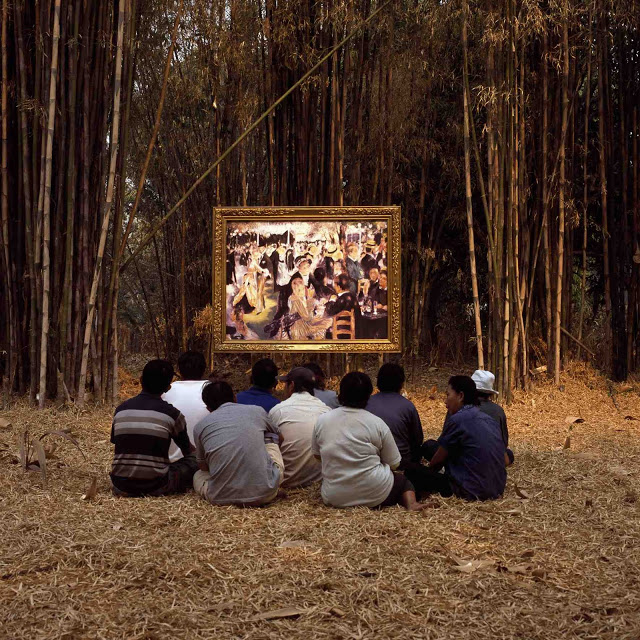
Conceptual artist Araya Rasdjarmrearnsook works and teaches in Thailand. For the Two Planets series Rasdjarmrearnsook made photographs and videos of Thai farmers on their home ground confronted by massively framed masterpieces of 19th century French art.
In an interview here Rasdjarmrearnsook explained the intention behind the project:
I am currently working with traditional sculpture and painting which will be videoed. I want to make and film a masterpiece; but a masterpiece for Thai farmers. No-one talks about Thai farmer’s values. Here I will use video not to register the so-called real but as a vehicle for expressing something like fantasy.
Tuesday, December 18, 2012
New container in Alg-a
On September 2011, Cidade da Cultura de Galicia hosted the I
Encuentro de Artistas Jóvenes where 100 young creators could share and discuss about current position of the artist and the future of contemporary art production.
After meeting participants were invited to make a presentation in a container located at Cidade. This proposal was the collective project "Container Inside".
A modular structure attached to Biblioteca de Galicia, or what is the same, a container as exhibition space, library and documentation center. A space with proposals of creators participants.
On summer 2012, and before arrival of the second edition of his meeting, it was time to decide what to do with this container
From Rural C we proposed to donate to Alg-a Lab, association with whom we work and collaborate, developping different projects.
Following discussions of the participants, this was the option granted by people. So the container arrived in Alg-a, in Valadares.
Now, to use, reuse it and reuse it again in its new location.
After meeting participants were invited to make a presentation in a container located at Cidade. This proposal was the collective project "Container Inside".
A modular structure attached to Biblioteca de Galicia, or what is the same, a container as exhibition space, library and documentation center. A space with proposals of creators participants.
Container arriving at Cidade da Cultura.
From Rural C we proposed to donate to Alg-a Lab, association with whom we work and collaborate, developping different projects.
Following discussions of the participants, this was the option granted by people. So the container arrived in Alg-a, in Valadares.
Now, to use, reuse it and reuse it again in its new location.
Performance by Paulina À la Plage at Alg-a Lab on new container´s opening day.
Sunday, July 17, 2011
Summer Exhibitions in Spain
A look at the galleries and art spaces in Madrid this summer through the posts made on www.ruralc.com. The exhibitions are here because the subject matter is related to the landscape / rural culture, bon appetit! Thanks to all artists and galleries for allowing the use of images.
Javier Ayarza "Extras" at Fúcares Gallery.
Manuel Muñoz at Metta Gallery.
Perejaume "Exvotos" in Soledad Lorenzo.
Open Photo Cuenca 2011 (PHE)
Glen Rubsamen exhibition at Benveniste gallery.
Ricardo Cases in La Fresh Gallery.
Antonio López & her summer retrospective at the Thyssen Museum.
Julián Pérez & José Jurado #Puertas exhibition until september 21 in the ECAT space of Toledo.
EFTI School photo collective at Círculo de Bellas Artes terrace.
Photo by Silvia Gurrea-Nozaleda.
"The power of doubt" at ICO museum inside PHotoEspaña 2011. Curated by Hou Hanru.
Thierry Fontaine
Wangechi Mutu
Dan Perjovschi
Bernardí Roig installations in Max Estrella Gallery.
Another Bernardí Roig "pop" artwork.
Work by the artist Jeroen Diepenmaat in the exhibition "After silence"
Inéditos 2011 in La Casa Encendida.
Subscribe to:
Posts (Atom)