Tuesday, November 27, 2012

NOISEmede, festival of noise and electronic music

Last 18 and 19 of August of 2012 we organized a festival of noise and electronic music in SAUMEDE, a small village in Ourense, (Galicia).
A RuralC event in collaboration with ACAS association.

Saumede has become a project of rebuilding an abandoned rural space. The place is a small village located in a biosphere reserve in south of Ourense. The association has rehabilitated houses and paths, and develops cultural activities since 2011, dynamizing socio-cultural life of the area.

Our contribution was to introduce and coordinate a day of noise in the village landscape.
For that we invited to perform various musicians and Galician groups.
Here you can watch a video summary of concerts:


Poster NOISEmede 2012


A morning visit in the village, visiting houses in process of restoration

A hundred-year-old chestnut tree

Sound check of 23 Red Ants


Hedonistas in Touch & Play 

"Neanderled", light installation by DIOSK


Koroiev performing among day and night


23 red ants

Os Gru
Pictures by Juanma LoDo & Fur Alle Falle. 

REMAGOSTO

REMAGOSTO is a Micro-festival, participatory and familiar.
Located in Piñeiro de arriba, Vilachá, Monfero, A Coruña, Galicia.
A RuralC activity coordinated by Fur Alle Falle .

Magosto is a party linked to Autumn and chestnut.
In Galicia chestnuts goes with mushrooms, first turnip´s green sprouts, good scads, and the beginning of new winter garden.
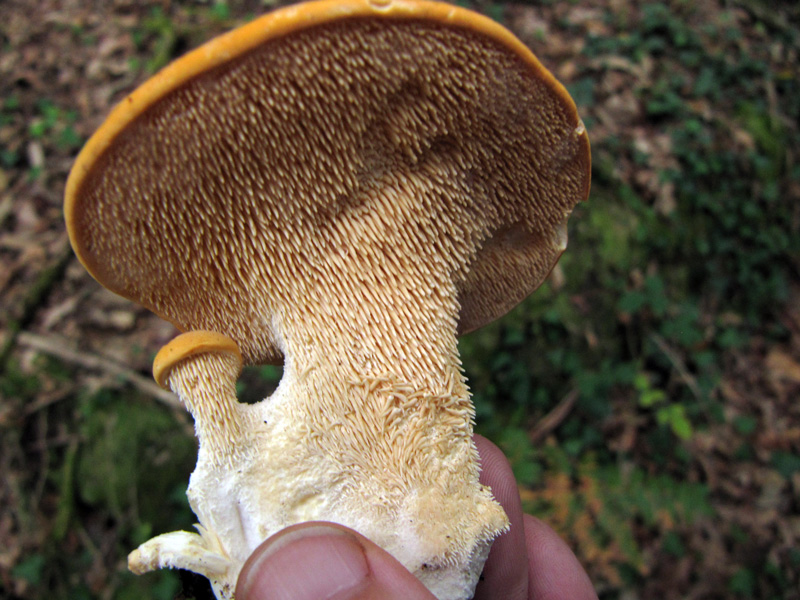
This week in mid-November in the woods we found many Hydnum repandum / rufescens, mushrooms colloquially called cow tongue or cat tongue.  The Hydnum family is characterized by these kind of stings they have under the cap (not sheets or pores).


Usually not attacked by the larvae, their flesh is dense and slightly bitter flavour, soft and pleasant. One Sunday was a good day to make them such stew of chickpeas, so it was the main course of Remagosto. After lunch, sweet "larpeiras" and liquors, including a small cake made with fluorescent yellow corn flour

 
After this after lunch, the concert of the engineer and poet Federico Flesfa Dublé. Galician bricotrance prepared with beautiful guitar arpeggios chained with voices, batteries with cushions, and fun polyphonic metals. It was in the loft of the house. A loft whose irregular beams were brought in 1920 from Eume´s woods.


vídeo by Marcos Nine

And after this concert, a session of slides and 16mm cinema, all with found-footage material, found or recycled. Reviewed and turned by Marcos Nine, Juan Lesta, Ximena Losada and Belén Montero.


"flounces to fly, gyga-wardrove, eels of the Albufera lagoon, indignant hostesses, children on boat, where was this airport?, sweeping a crystal Christ ..."
 

After these screenings we had improvised songs with Os Gru, talks and walk by plot, with the sound of a little owl and starry sky. We were 12 hours.

Friday, August 31, 2012

Andres Montes residence at RC Villanueva de los Infantes

The Mexican artist living in Madrid Andres Montes was developing two projects at our headquarters in Villanueva de los Infantes (Ciudad Real) during the weekend from 8 to 11 June 2012.
RuralC supported the project by providing room and board, counseling, documentation and dissemination activities.

The project 
WHOLE HOUSE consisted of a performance in which Andrew dug a hole in the ground, building a living space.

We streamed his performance in La Mora, internationalizing a isolated action happened in the "middle of nowhere" (10 people from several countries were connected).


here you can view the streaming videos.

For the hardness of the ground Andrés had to make the performance in two days.


The project  TRANSPOSED | DISPLACED | TRANSPLANTED, is a continuation of his project Tactics Identity. Andrew explores the territorialization of space as constitutive of identity tool. It involved two rural areas in two different geographies: La Mora, an special spot in Villanueva de los Infantes, and the outskirts of Madrid.


1m2 of soil removed from each place to "transplanted" into the other and create a photographic record of this action. The intention is to explore, because of subtle mediation, the poetics of displacement, the thought of uprooting.


+ info at his web  http://regionestransitorias.wordpress.com/transposed-displaced-transplanted/

There was also a public presentation of their projects and career in RC Villanueva de los Infantes
It was a pleasure to have Andres on RC Infantes and be partakers of his actions.

Friday, May 25, 2012

Traditional organic construction at Alquife (Granada)

Rural C in collaboration with Artediverso have made this project of restoration and traditional construction.

We have rehabilitated and saved an old house, made with stone, clay, lime and timber, which was arranged last over 50 years. Our mission was to perform the work required to restore the house habitable again to develop in the future cultural activities.

The house is located at Alquife (Granada), situated in a prime location with a wide view, on the west the Sierra Nevada alpine landscape, on the est the Castle of Calahorra and the intuition of the desert of Almeria.


Here we report the process:

0 - Throughout the process we made a work of separation and recovery of the original materials for reuse on site.

1 - Fixed base wall of the first floor. Reinforcing to the natural fall of the hill. We use stone, clay, lime and good slabs.

2 - On the west side reconstruct the damaged stone wall and raise the rest of the wall with thermal clay brick and sand paste with natural hydraulic lime (originally also was brick wall).

3 - Dismantle the roof insulation and the old hurdle. The roof surface is quite large, 150 m2. We clean all the covering material up to the rafters.


4 - We removed the 4 beams broken on the north side, also dismantle all beams extending the south side of the house to be invaded by termites. We have rescued and clean up those who remain healthy, brushing and treating with salt water and chili oil.

5 - recovered wood eaves and clean up with the same procedure.

6 - Insert new poplar beams, treating them first..


7 - Place the hurdle and extend above the insulation board harmonizing levels. The insulation board consists of pine bark, collected waste in forestry work in the area, together with sifted clay and natural hydraulic lime.


8 - We cleaned the original tiles, around 5.000, ordering them for using as "rivers" or "covers".


9 - Placing tiles. We place a tile of the roof of Rural C Villanueva de los Infantes.

Originally the house was a compact layer of hydraulic mortar adhering the tiles. At present most of the houses in the village have the tiles places in a dry process (without mortar).

We decided to use fine sand with natural hydraulic lime of 3.5 at a ratio of 3/1, based on the original mode, but saving in the fill of hydraulic mortar. This system creates an air chamber that allows to maintain optimum temperatures inside the house.


We use traditional brick together with a mortar composed of fine sand and natural hydraulic lime 5, in a ratio of 3/1 to construct the chimney.




Tuesday, February 28, 2012

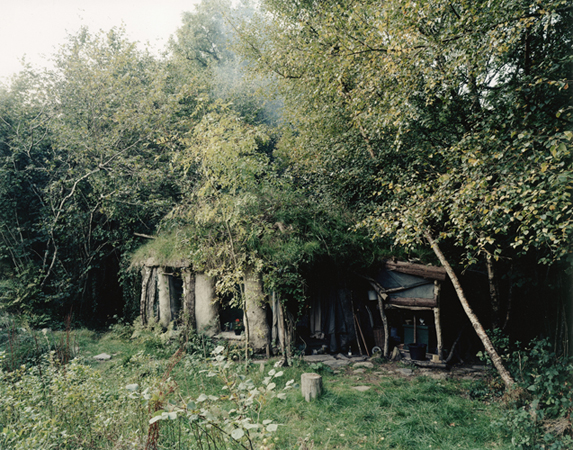
David Spero "Settlements"

'Settlements' is an ongoing photographic record of self-built homes and structures in a 
number of low-impact land-based communities in Britain that wish to explore ways of 
living on the land in an ecologically sustainable way. Their aim is to be at least partially 
self-sufficient. They use renewable energy sources, grow food, and recycle and locally 
source building materials. These photographs chart the evolution of these communities 
through their homes, communal spaces and infrastructure.
Planning conflicts surrounding these structures raise questions about planning values and 
judgments, the privileged gaze, aesthetic elitism and who is allowed access to live and 
work on the land.  The communities have been slowly challenging and shaping changes in 
judgments on planning laws and its application at a local level.

Photographs
'The Longhouse'  communal space and new kitchen, Steward Community Woodland, Devon, November 2004 
John, Sonya, Daisy, Marley & Asher's, Steward Community Woodland, Devon, August 2004
Brigyn's, Tir Ysbrydol (Spirit Land), Pembrokeshire, October 2004
Emma and John's, Tir Ysbrydol (Spirit Land),Brithdir Mawr,  Pembrokeshire, October 2004.
Communal round house and kitchen, Tinkers Bubble, Somerset, February 2006
Mary and Joe’s, Tinkers Bubble, Somerset, June 2004 
Josh's garden and new communal yurt, Land Matters, Devon, November 2008
Robin and Annie's and communal garden, Land Matters, July 2009
All prints are 604mm x 750mm

Photographs by David Spero 

Saturday, February 25, 2012

José Navarro "Trashumantes"


Every November a small group of Spanish semi-nomadic shepherds from Teruel set off on a 3-week long journey and walk a flock of 5,000 sheep across 250-miles of Spanish landscapes. They leave behind the exhausted summer pastures of their native Serrania de Albarracin and head for greener, winter hillsides in Jaen, Andalucia.
They are the ‘trashumantes’, the very last ones who still practise a 1000-year-old tradition on such a large scale.
I recently accompanied them for the whole duration of their seasonal migration. This project took three years from inception of the idea to realisation. A series of sheep epidemics and the subsequent government ban of nation-wide movements of animals almost finished off the already precarious lifestyle of the trashumantes.
During the journey I felt the pervading sense of camaraderie amongst them and witnessed how the activity completely defines who they are. They are trashumantes and could not, would not, be otherwise. Sadly, they’re often seen as an anachronism in our technology-driven society. However, for the trashumantes the journey is not an exercise in nostalgia but a cost-efficient, environmentally-friendly alternative to road transport: they save money by walking the sheep instead of taking them in lorries. So the activity is unquestionably rooted in a modern market economy.
I don’t know how long they will keep doing it, but I hope that the young shepherds who came with us eventually take over the responsibility from the core of mature trashumantes who drove the expedition. It would be a great loss if the drovers’ tracks eventually faded in the landscape because no trashumantes walk them anymore.
All images copyright © José Navarro